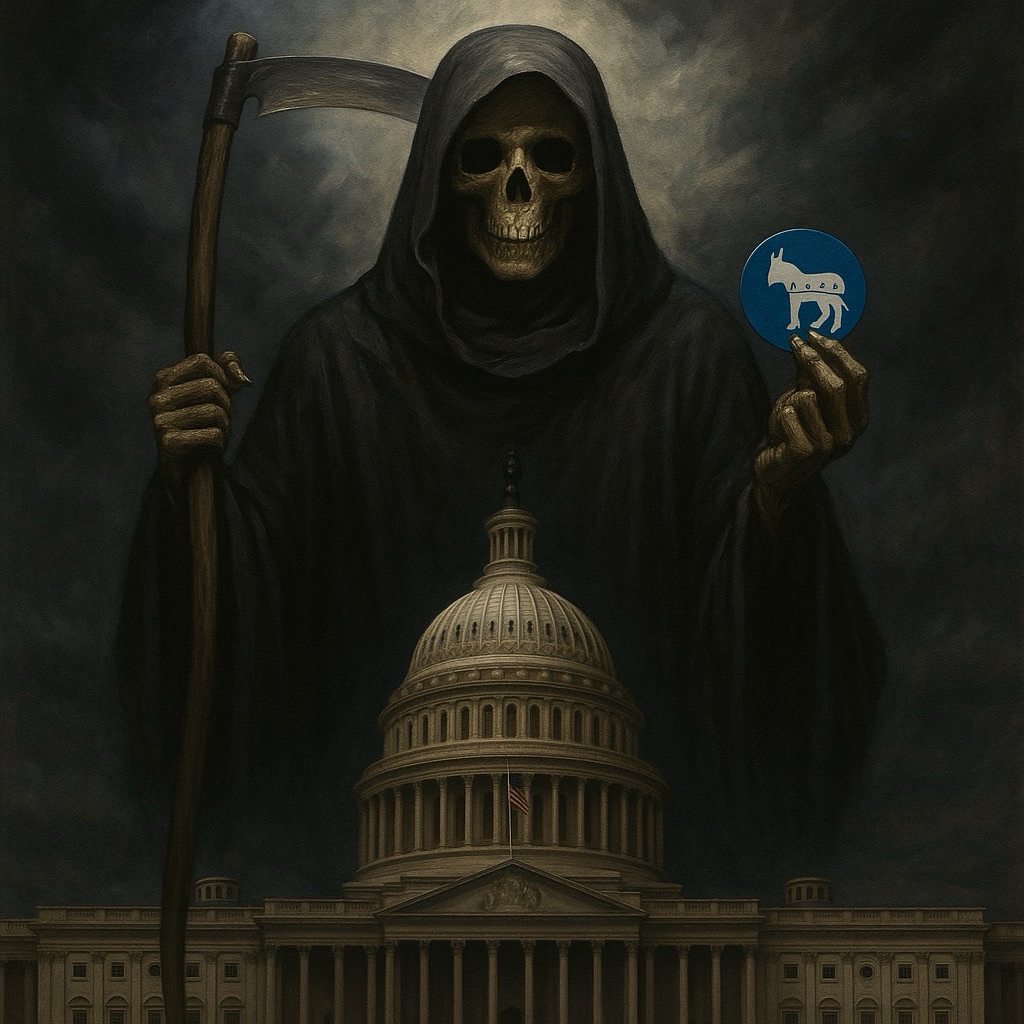
The best guests leave before the host starts clearing plates. Some Democrats seem determined to overstay, and it’s starting to show. No one wants to say it, but the party’s getting awkward.
My career has kept me in or around politics for quite some time. I’ve worked in strategy. I’ve written for campaigns. I’ve watched the machinery of politics grind forward from both the inside and out.
And one thing you learn fast—whether you’re counting votes or dollars—is that timing matters. And lately, the clock has been running out.
Since November 2022, eight sitting members of Congress have died while in office. All of them were Democrats. The most recent, Representative Gerry Connolly of Virginia, passed away on May 21, 2025, at the age of 75 after a long battle with esophageal cancer. He was the third House Democrat to die in as many months, following Reps. Sylvester Turner and Raúl Grijalva. Their absences weren’t just emotional losses or momentary footnotes. They were numerical. Tangible. Consequential.
A Republican tax bill—regressive, cruel, and predictably celebratory of the ultra-wealthy—passed the House by a single vote. 215 to 214. Had any of the three recently deceased Democrats been alive to vote, the bill would have failed.
Today, there are tragedies. And there are tipping points.
This is both.
The Democratic Party is aging. But more precisely: it is dying. Slowly, publicly, and with very little sense of self-awareness. And no, I don’t mean the party is irrelevant. It’s not. In fact, it’s often the last line of defense between this country and something much darker. But it’s governed—too often, too predictably—by people who mistake institutional memory for prophetic insight.
The average age of House Democrats is several years higher than that of their Republican colleagues. The Senate is worse. And many of the party’s most influential power-brokers—committee chairs, ranking members, even presidential candidates—are well into their 70s or beyond. This isn’t about ageism. This is about realism.
A healthy democracy relies on succession. Renewal. The passing of torches. Instead, we’re watching the slow calcification of a movement that once prided itself on youth, change, and vision. The party of John Lewis and Shirley Chisholm is now too often the party of actuarial tables and whispers in the cloakroom about who might make it to January.
I wish I were exaggerating.
The Republican Party is many things—corrosive, authoritarian-curious, shamelessly cruel. But it is not burdened by a reverence for seniority. That is, in part, why they win. They run young candidates. They promote youth. They let people like Matt Gaetz and Elise Stefanik, vile as they may be, take leadership roles early. They make room. And in doing so, they signal something powerful: we are looking forward.
Democrats, by contrast, cling.
We didn’t choose Biden for his vision—we chose him because he felt familiar, predictable, safe. We elevate seniority like it’s inheritance, not a privilege renewed by trust. We call it respect, but too often it’s fear of rupture, fear of disloyalty, fear of stepping out of line. And so the next generation—the most diverse, the most progressive in party history—waits, watches, and wonders if their moment will ever come.
Too often, those wings turn into exits.
We’ve seen glimpses of what could come next: Maxwell Frost in Florida, a Gen Z organizer who talks like the present and votes like the future. Michigan State Senator Mallory McMorrow, whose viral floor speeches managed to stir both donors and disillusioned voters. Harris County’s Lina Hidalgo, proving executive competency doesn’t have to wait for a gray hair count.
Some of it is cultural. The Democratic Party reveres experience—a virtue in moderation, a vice when left unchecked. Longevity becomes its own justification for power. And because Democrats don’t believe in ideological purity tests, they’ve often defaulted to a more elusive standard: having “been there” long enough to count.
But what happens when those who’ve been there can no longer show up?
Representative Donald Payne Jr. died in April 2024 of complications from diabetes. He was 65. Sen. Dianne Feinstein died in office at 90, after years of mounting concerns over her mental acuity. Rep. John Lewis died in office from pancreatic cancer at 80. These are public servants of remarkable legacy. But legacy is not a legislative strategy. Reverence does not cast votes.
We already impose minimum ages for office: 25 to run for the House, 30 for the Senate, 35 for the presidency. Why not consider maximums?
A constitutional amendment is the most direct (and least likely) route—requiring two-thirds of Congress and ratification by 38 states. That will not be happening. But legislative bodies can adopt internal reforms without an amendment. For instance:
- Term limits for committee chairs and leadership roles.
- Mandatory cognitive and health assessments for members over a certain age.
- Voluntary retirement incentives, including legacy recognition, pension bonuses, or non-legislative roles.
- Transparency requirements for medical records for members over 65.
Is it uncomfortable? Yes. But so is losing a critical vote because someone didn’t live long enough to cast it.
And, crucially, it’s wildly popular. Polling consistently shows strong public support for age limits. A 2023 YouGov poll found that 68% of Americans favor maximum age limits for elected officials, including a majority of Democrats and Republicans. In a moment of profound polarization, this is one of the few ideas with truly bipartisan appeal.
Imagine the contrast it would create: a Democratic Party that begins electing younger candidates, grooming new leaders, rotating power proactively instead of waiting for death or scandal. A party that doesn’t just survive Republican extremism, but defines the future on its own terms.
What would it mean to have a Democratic House caucus with a median age in the 40s? To have leaders who understand digital culture because they live in it, not because someone briefed them on TikTok in committee? What would it mean to have a generation of lawmakers who view climate change not as an abstract risk, but an imminent crisis that will define their lifetimes?
It would mean energy. Urgency. Clarity.
It would mean a party that does not simply remember Selma, but embodies its call: keep walking.
Governing until death is not a sign of commitment. It is a refusal to plan for succession. And refusal to plan is, itself, a form of malpractice.
We are at a moment where climate collapse is accelerating, authoritarian movements are metastasizing, reproductive rights are being gutted, and the algorithms that govern our lives are being written in real-time. We cannot afford to be governed by people whose instincts are to table a decision for another committee hearing.
The future is not theoretical. It’s now.
And the party that forgets to renew will eventually forget to win.
We won’t pass a constitutional amendment tomorrow—but we don’t need to. Change can begin within the party.
The Democratic Party should adopt a voluntary age cap for leadership roles—say, 68. It should invest deeply in leadership pipelines from underrepresented communities. It should create a shadow cabinet of Gen Z and millennial lawmakers. It should implement a mentorship model that prioritizes power-sharing over power-hoarding. And it should partner with grassroots youth organizations to co-create not just campaigns, but policies.
This isn’t abstract. It’s architecture. And it’s overdue.
This is not about kicking elders out of the room. It’s about making sure the room is big enough for the next generation to enter before they decide to build their own house down the street.
We honor the past by preparing for what comes after.
The best guests leave before the host starts clearing plates. The worst stay until even the DJ has given up.
This doesn’t have to be a death knell. It can be a handoff.
But we’re nearly out of time. And the longer we wait, the fewer chairs there’ll be left to pass on.
Trent Harrington writes and works at the intersection of storytelling, strategy, and the stubborn hope that ideas still matter. And he cusses a little.
I don’t write these for attention because they do not receive any. I write them to not feel insane. And sometimes when I’ve taken my 5-Hour Energy shot and Adderall too late in the day. If you liked it, please feel welcome to pass it along to others you think might, too.

Follow Trent Harrington on Substack Threads
Trent is a political strategist writing and working at the intersection of storytelling, strategy, and the stubborn hope that ideas still matter. With the added bonus of cussing a little.
INTERVIEW COMING!
Subscribe to never miss an article in the LGBTQ Authors Series or from the other important voices and topics we share at Four Elements Press.

Schedule writing/publishing consultations on Patreon or contact us below.
Click for Submissions and Literary Services




Make a one-time donation
Make a monthly donation
Choose an amount
Or enter a custom amount
Your contribution is appreciated.
Your contribution is appreciated.
DonateDonate monthly

Discover more from FOUR ELEMENTS PRESS
Subscribe to get the latest posts sent to your email.

[…] The Guests Who Won’t Leave the Democratic Party […]
[…] The Guests Who Won’t Leave the Democratic Party […]