

The Fifty-State Delusion
Every few years, someone at the DNC pulls Howard Dean’s old playbook off the shelf and treats it like gospel. They dust it off, talk about grassroots, and preach the idea that Democrats should compete everywhere. They tweet about expanding broadband in Nebraska. They send field organizers into deep-red counties in Idaho. They produce campaign videos with students from red-leaning suburbs talking about reproductive rights. The message is clear: if we show up, we can win.
They’re not wrong to want that. But they’re wrong to believe that’s enough.
I don’t say that lightly. I came of age politically in the wake of Dean’s movement. I believed in it. Hell, I benefited from it. The idea that Democrats could be competitive anywhere if they showed up everywhere was a powerful antidote to the fatalism that defined red-state liberalism for decades. We were told to organize in every county, register voters door-to-door, and build permanent infrastructure—not just drop in with a robocall and disappear.
But in 2024, after 20 years of preaching the gospel of “everywhere,” the results were clear: it didn’t work. Or rather, it stopped working.
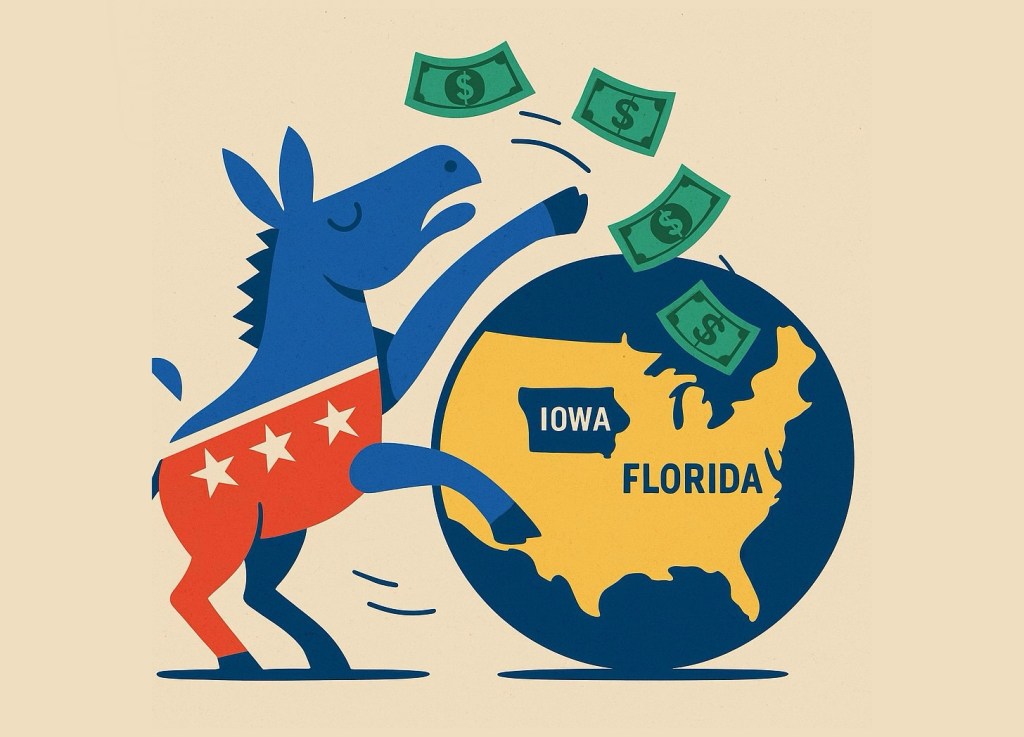
If you want to know how we got here, you need to understand two things: demographics don’t vote, and hope doesn’t govern. The DNC has built an entire generation of strategy on vibes—on the dream of a 50-state future where every American voter might, one day, feel heard. But we’ve mistaken outreach for outcome.
This isn’t a condemnation of organizing. It’s a plea to be honest about what organizing can and can’t do under the current system. You can outwork the GOP in Alabama for six months, but you’re not beating a +30 Republican baseline with vibes and van rides. You can knock every door in Missouri, but if a voter’s deepest identity is that they hate “wokeness,” it doesn’t matter how compelling your Medicaid expansion argument is.
Democrats are spending time, talent, and treasure in places that are structurally, culturally, and electorally rigged against them. And while that’s morally understandable, it’s strategically suicidal.
Take Florida. The Democratic Party poured tens of millions into the state over the past decade, convinced that demographic shifts—especially among Latino voters—would flip the state blue. What happened instead? Ron DeSantis won reelection by nearly 20 points. Republicans won control of Miami-Dade. And Democrats lost nearly every competitive seat, even as abortion rights and gun control polled well statewide.
It’s not just that Democrats lost. It’s that they lost after doing everything they were “supposed” to do: youth turnout, Spanish-language ads, suburban persuasion, voter registration drives. None of it cracked the shell.
Meanwhile, Arizona—a state with fewer electoral votes, but better structural conditions—was starved of attention until the final stretch. When Democrats finally went all-in, they won the state. Twice.
This isn’t just about money. It’s about priorities. Political capital is finite. Every dollar you spend trying to win over a voter who fundamentally hates your existence is a dollar you didn’t spend turning out the ones quietly hoping you’ll fight for them.


Texas might be the most dangerous mirage of all.
Democrats have been chasing Texas since Bush was governor. And to be fair, the long-term math once looked promising: growing cities, diversifying suburbs, and a rising Latino population. But time has exposed a painful truth—Latino voters are not a monolith, and conservative cultural identity often trumps progressive economic messaging.
The left told itself a story: that demography would deliver victory. But reality bit back. Voters in South Texas shifted right. Republicans doubled down on evangelical outreach, oil and gas populism, and law-and-order rhetoric. The result? Democrats have stalled out in statewide races for decades, coming close only once—and even that required historic turnout, anti-Trump energy, and a charismatic candidate who was practically invented in a lab to appeal to both Austin and Amarillo.
Today, Texas Democrats still don’t control a single statewide office. The statehouse remains gerrymandered beyond reason. And yet, national Democrats continue to treat it as a crown jewel in waiting.
At what point do we admit it might not come?
This country is not built for national consensus. It’s built for regional entrenchment. The Senate guarantees that Wyoming gets the same vote as California. The Electoral College gives outsized weight to rural, white, aging voters. And the House is still shaped by gerrymandering so intense it borders on cartoonish. Add to that a Supreme Court captured by a reactionary bloc, and you have a system in which geography matters more than ideology.
We are not a 50-state party. Not really. And the sooner we stop pretending, the more we can focus on building power where it’s actually possible.
That doesn’t mean abandoning red states. It means redefining success within them. Maybe it’s not about flipping the state—maybe it’s about flipping a school board. Maybe it’s not about a Senate seat—maybe it’s about a ballot initiative, a local prosecutor, a mayoral race. Those things matter. But they require a different kind of investment. One that centers lived reality, not presidential fantasy.
Imagine what the Democratic Party could do with all the resources currently funneled into pipe dreams.
You could double down on turnout operations in Pennsylvania, Michigan, Wisconsin, Georgia, Nevada, and Arizona—states that actually decide presidential outcomes. You could fund full-time organizing staff in North Carolina, which is competitive but often neglected. You could invest in defending voting rights and reproductive access in the courts. You could build media ecosystems to counter right-wing propaganda in places where voters are reachable but underserved.
You could, in other words, win.
But that requires giving up the dream of being liked everywhere. It means embracing the reality that some voters cannot be persuaded, and some states are too far gone—for now. It means treating politics like what it is: not a morality play, but a contest of power.
Democrats have spent too long trying to be the party of everyone. But pluralism doesn’t mean suicide. And fairness isn’t a strategy when the other side is burning books, rigging maps, and pushing constitutional conventions.
Yes—constitutional conventions. While we waste millions trying to flip Iowa, Republicans are laying the groundwork for an actual Article V convention to rewrite the Constitution. They’re not just playing to win; they’re playing to rule.
If Democrats don’t wake up, they’ll keep getting outmaneuvered by a party that doesn’t care if it ever wins another majority—so long as it never has to give up power.
Here’s what the post-2030 landscape looks like if nothing changes: population shifts accelerate in blue states, deepening the imbalance in the Senate and Electoral College. Young people continue to cluster in urban centers, making it even harder to win suburban-rural districts. Climate disasters, economic shocks, and conservative media will radicalize the right further. And every election the Democrats narrowly win will be treated as illegitimate by a movement that no longer believes in democracy.
The time to adapt is now. Not later. Not once we “hold the House.” Not once we “flip the statehouse.” Now.
This is not a call to retreat. It’s a call to choose our battles. To stop throwing good money after bad. To reject the delusion of 50 states and embrace a strategy of decisive, measurable, unapologetic power.
The old map is dead. It’s time we stopped marching in circles trying to resurrect it.
Because if we don’t, the only thing we’ll be competing for in 2036 is who gets to write the obituary.
To Trent’s Substack Article
Recommend TRENT HAS THOUGHTS to your friends
Essays, rants, and personal dispatches from a Southern strategist turned writer. Politics, memory, creative recovery, emotional wreckage, and the occasional text you’ll regret reading twice.

Follow Trent Harrington on Substack & Threads
About the Author
Trent Harrington lives in Nashville, studied political communication at The University of Alabama, built an award-winning agency, and led successful campaigns across the South. His work lives at the intersection of storytelling, strategy, and the stubborn hope that ideas still matter.
About the Author
Trent Harrington is a Nashville-based strategist, storyteller, and creative obsessive with deep roots in Alabama. He studied political communication at The University of Alabama, built an award-winning agency from the ground up, and led successful campaigns across some of the toughest terrain in Southern politics. His work lives at the intersection of memory, grit, and gay defiance – equal parts strategy and soul.
More by Trent:
Subscribe to never miss an article in the LGBTQ Authors Series or from the other important voices and topics we share at Four Elements Press.

Click for Submissions and Literary Services
Schedule writing/publishing consultations on Patreon or contact us below.
Posts




Make a one-time donation
Make a monthly donation
Choose an amount
Or enter a custom amount
Your contribution is appreciated.
Your contribution is appreciated.


Discover more from FOUR ELEMENTS PRESS
Subscribe to get the latest posts sent to your email.
